Signs you need this
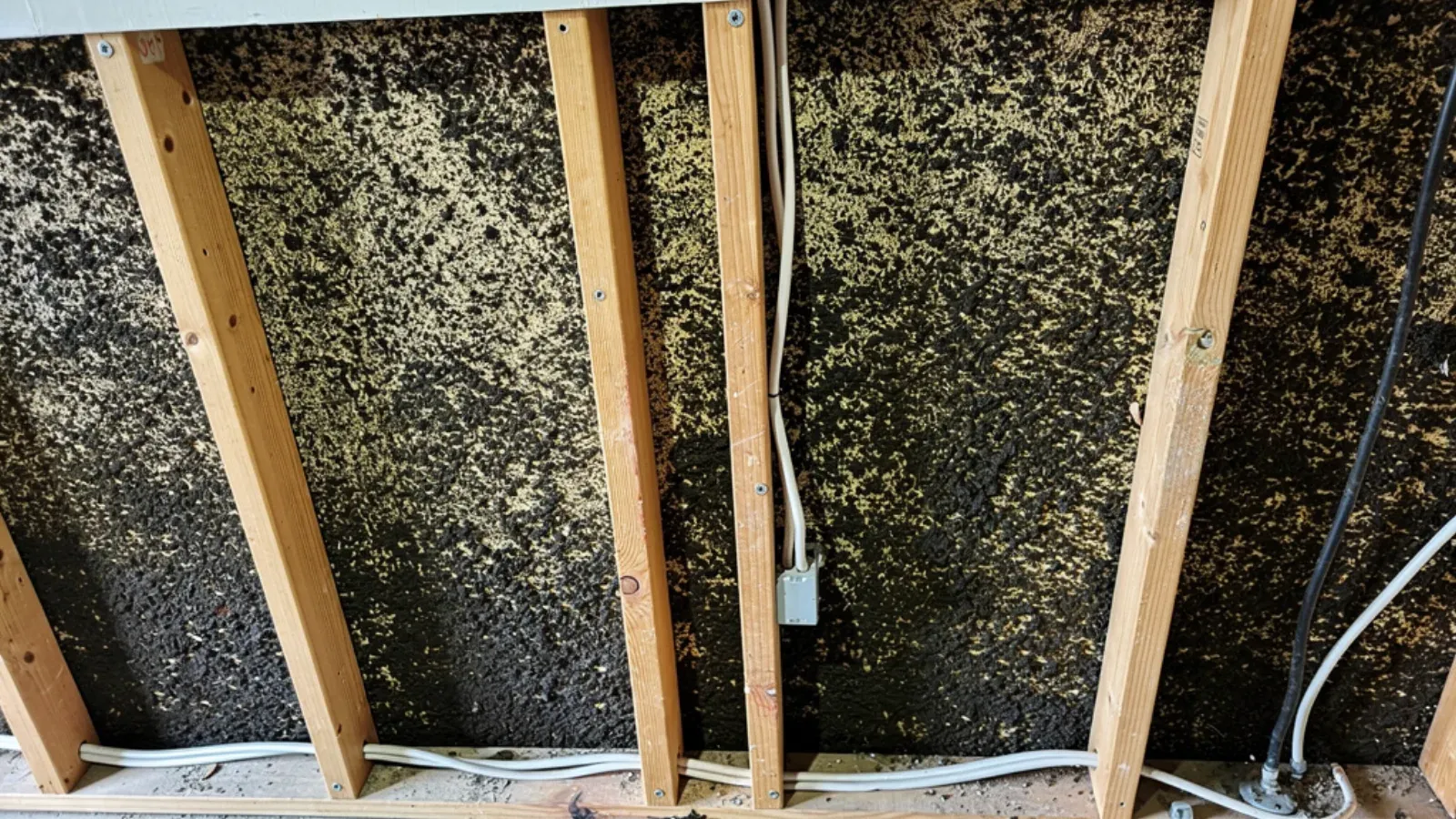
- • Dark speckling or a fuzzy black-green film creeping up the lower few feet of a basement wall
- • A persistent musty, earthy smell that returns no matter how often the room is aired out
- • Drywall that has gone soft, chalky, or discolored behind furniture, along the sill, or under a window
- • Paper tape lifting and staining in a damp finished basement or a humid ground-floor rental unit
Why mould on drywall is a biology problem, and why paint-over always fails
Norwalk Drywall & Plaster replaces mould-damaged drywall in the damp basements and humid lower levels of West Norwalk, Cranbury, and Brookside, where the wall is not just stained but colonized. The distinction matters, because mould is a living organism, not a mark on the surface. Drywall is an ideal food source: the paper facing is cellulose, and once relative humidity in a below-grade room stays high enough, spores that are always present in the air settle into that paper and grow. What a homeowner sees as dark speckling on the bottom few feet of a basement wall is a colony whose roots, or hyphae, have already penetrated into the paper and the gypsum core behind the visible edge. That is why a musty smell keeps returning after the room is aired out, and why the growth reappears through a fresh coat of paint every time.
Painting over mouldy board is the most common and most futile fix. Paint seals the surface for a few weeks, then the colony pushes back through, because the paint never touched the mould living inside the board. We do not coat contaminated drywall. We cut it out, and cut a margin past the visible mould line rather than stopping at the edge of the stain, since the growth extends into the board beyond what shows. Norwalk’s conditions make this a recurring problem: the coastal humidity that hangs over Fairfield County all summer, basements that take moisture through the grade, and the older two- and three-family rental stock where ground-floor units run damp season after season. Removing the board is only half the answer. If the moisture source stays, new drywall in the same wet basement simply becomes the next colony, so we identify the dampness and advise on controlling it before rebuilding.
Where a drywall crew’s work ends and a remediation firm’s begins
Norwalk Drywall & Plaster draws a clear line between what a drywall crew owns and what belongs to a dedicated remediation firm, because pretending the two are the same is how people get hurt and how contamination spreads. For small, contained growth on a lower basement wall, we handle it directly: setting containment so spores are not carried into the rest of the home, removing and bagging the contaminated board, exposing and checking the framing, and rebuilding. For heavy or airborne contamination, the right move is to coordinate with a remediation specialist who handles the cleaning, negative-air containment, and clearance testing before any new board is hung. We stage the drywall replacement to follow that clearance rather than sealing a wall over a space that has not been verified clean. Being honest about that boundary is part of the service.
The rebuild is where the repair either lasts or repeats. In a damp or below-grade Norwalk space, we specify mould-resistant board, the purple and fiberglass-faced products like USG Mold Tough, Gold Bond XP, and DensArmor, over standard gypsum, because standard paper-faced board in a humid basement is an invitation to start the cycle over. We tape and coat to match the surrounding wall, prime with a stain-blocking primer, and finish the section so it blends. The payoff for a homeowner or a landlord is a wall that is clean, sound, and built to resist the exact conditions that grew the mould the first time, instead of a cosmetic patch that is fuzzy and black again within a year.
Materials & standards
Products & materials we use
- purple/mould-resistant board (USG Mold Tough, Gold Bond XP)
- DensArmor
- CertainTeed
- stain-blocking primer
- setting-type joint compound
Standards & codes we work to
- 2022 CT State Building Code (2021 IBC/IRC)
- ASTM C1396/C840
- GA-214 finish levels
- EPA RRP
What the terms mean
- cut back past the mould line
- containment
- mould-resistant board
- remediation clearance
- moisture-source correction
- spore control
Options & variants
| Option | When it applies | Cost |
|---|---|---|
| Lower-wall cut-and-replace | Growth confined to the bottom few feet of a basement wall | Smallest scope; mould-resistant board on the rebuild |
| Full-panel removal | An entire finished panel or run is contaminated | Adds disposal and larger containment |
| Mould-resistant rebuild | Any damp or below-grade space where standard board will regrow | Purple/mould-resistant board over standard gypsum |
| Remediation-coordinated replacement | Heavy or airborne contamination needing a remediation firm | Drywall staged after clearance; remediation is a separate scope |
What affects cost
- • How far the growth has spread, since we cut a margin past the visible mould line, not just to the edge of the stain
- • Whether a dedicated remediation firm has to handle containment and clearance before the drywall work begins
- • The board specified for the rebuild, as mould-resistant or purple board costs more than standard gypsum but is the point in a damp space
- • Disposal of contaminated board, which is bagged and handled rather than tossed with ordinary debris
- • The underlying moisture source, because replacing board without addressing dampness only resets the clock
- • Access and finish level in a finished basement or occupied rental unit
What to expect
- 1
Assess growth and moisture
We assess the growth, find the moisture feeding it, and mark how far past the visible mould line the board has to come out.
- 2
Set containment
We set containment so spores are not spread through the rest of the home while the board is removed.
- 3
Cut back and bag
We cut back a margin beyond the growth, bag the contaminated board, and expose the cavity to check the framing.
- 4
Coordinate remediation where needed
Where contamination is heavy or airborne, a remediation firm handles cleaning and clearance before we proceed.
- 5
Rebuild with mould-resistant board
The crew rebuilds with mould-resistant board, tapes, and coats to match the surrounding wall.
- 6
Finish and advise on moisture
We finish, clean the space, and talk through keeping the moisture down so the growth does not return.
When this isn’t the right call
- If the board is wet from a recent leak but has not yet grown mould, water damage drywall repair is the better fit.
- If the discolored wall is original lath-and-plaster rather than drywall, plaster repair and conversion is the better fit.
Frequently asked questions
Can you just clean the mould and paint over the wall? +
Norwalk Drywall & Plaster does not paint over mouldy drywall, because the growth has roots into the paper and gypsum and comes back through fresh paint, so the contaminated board has to be cut out rather than coated.
How far past the visible mould do you cut? +
Norwalk Drywall & Plaster cuts a margin beyond the visible growth rather than stopping at the edge of the stain, since mould extends into the board past what shows on the surface.
Do I need a separate mould remediation company? +
For small, contained growth, Norwalk Drywall & Plaster handles removal and replacement directly; for heavy or airborne contamination we coordinate with a dedicated remediation firm to clean and clear the space before new board goes up.
What board do you use so the mould does not come back? +
Norwalk Drywall & Plaster rebuilds damp and below-grade walls with mould-resistant or purple board rather than standard gypsum, which resists the moisture that fed the original growth.
Why does the mould keep coming back in my basement? +
Norwalk Drywall & Plaster tracks down the moisture source feeding a return of growth and advises on controlling it, because new board in a wet basement will only grow mould again if the dampness stays.