Signs you need this
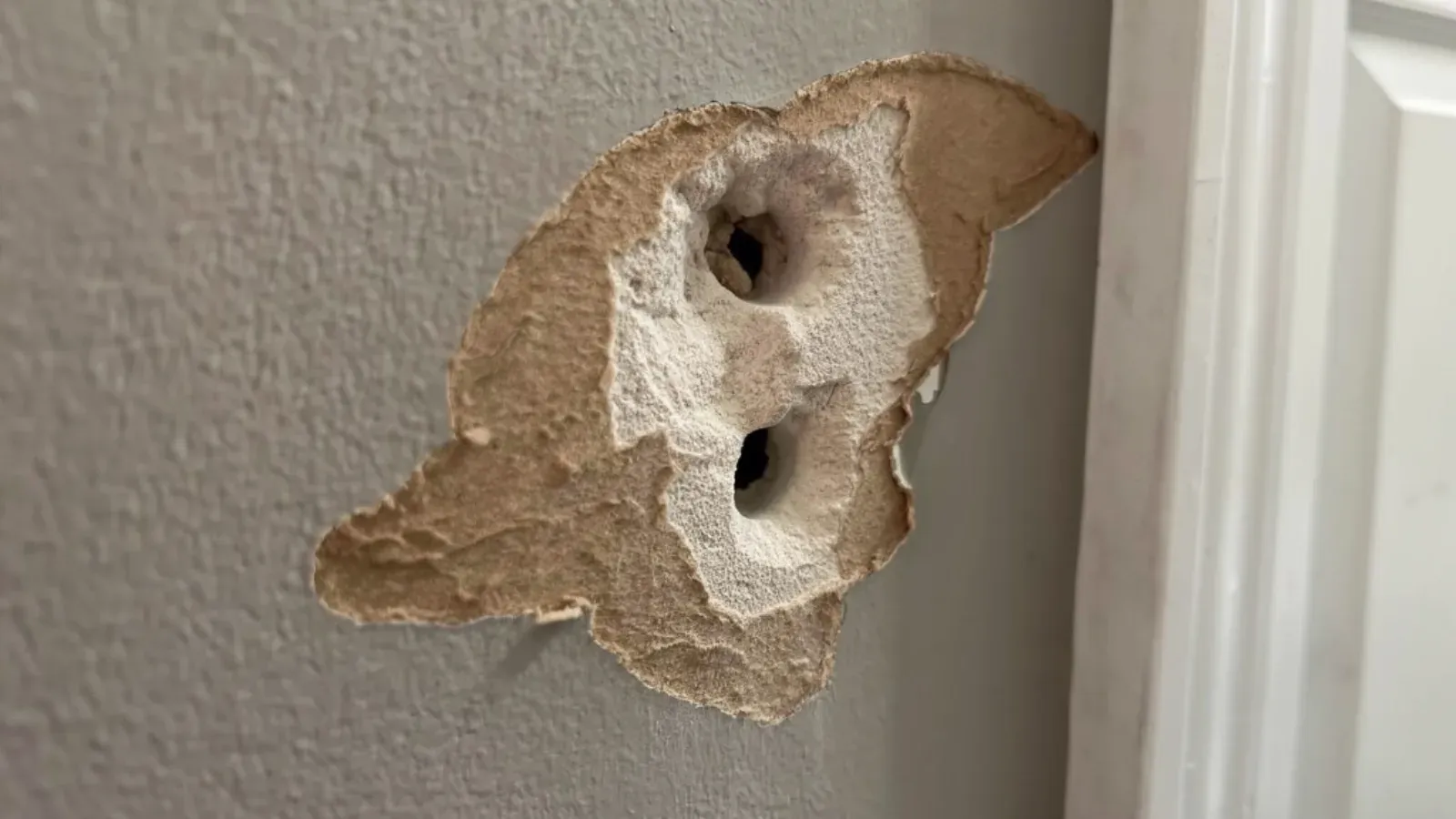
- • A hole from a doorknob, moving furniture, or a slammed door
- • Small dings, gouges, or a section knocked out by a dropped object
- • Loose or crumbling drywall around an anchor that pulled out of the wall
- • A single small crack after hanging a heavy mirror or shelf, not part of a wider pattern
The everyday hole: what actually makes a patch disappear
Norwalk Drywall & Plaster patches more doorknob holes, anchor pull-outs, and moved-furniture gouges in SoNo and East Norwalk’s rental stock than any other single job we run, and the difference between a patch that lasts and one that shows up as a shadow six months later comes down to two things: backing and feather radius. A peel-and-stick mesh patch stuck straight over a hole with no support behind it flexes every time someone leans on the wall, and that flex telegraphs through the paint as a faint outline no matter how well the compound was sanded. We cut the damaged area back to a clean shape, set in a rigid backing strip or a cutout patch screwed to the surrounding board, and only then tape and coat over it, so the repair has something solid behind it instead of floating on adhesive alone. The second piece is feathering: dragging each coat of compound six to eight inches past the edge of the patch instead of stopping right at it, so there’s no hard ridge for raking light to catch once it’s painted. Anchor pull-outs get an extra step, since the hole left behind is usually bigger than the anchor itself where the drywall crumbled around it, and packing that void with setting-type compound before the patch goes on keeps the repair from feeling soft when someone reaches for a picture hook in the same spot later.
Why turnover jobs in East Norwalk’s older multi-family buildings run differently than a single homeowner repair
Norwalk Drywall & Plaster treats a landlord’s turnover call differently from a single homeowner’s hole because the job is really several small repairs against one deadline, not one repair done carefully. A two- or three-family building in East Norwalk or SoNo built in the early 1900s has usually been painted and re-painted in different rooms at different times, so a hallway wall and a bedroom wall in the same unit can carry noticeably different sheens and even different underlying textures where a prior owner skim-coated one room and not another. We walk the whole unit first and group the damage by wall and by finish, so the multiple dings in one room get one texture match and one paint decision instead of treating each hole as its own micro-project. That batching is also what keeps turnover pricing efficient: setting up compound, sanding equipment, and a sprayer once for six spots across three rooms costs a fraction of what six separate single-hole visits would run. The tighter the move-in date, the more this matters, since a landlord losing rent for extra vacant days usually outweighs holding out for a marginally better price on a smaller job, and we build the schedule around that reality rather than a fixed one-size sequence.
Materials & standards
Products & materials we use
- USG Sheetrock
- FibaTape
- corner bead
- joint compound (setting-type vs pre-mixed)
Standards & codes we work to
- 2022 Connecticut State Building Code
What the terms mean
- backing strip
- mud and tape
- orange-peel / knockdown texture
- joint compound
Options & variants
| Option | When it applies | Cost |
|---|---|---|
| Small hole patch | Doorknob holes, anchor pull-outs, minor gouges under a fist-sized hole | Smallest job, often a single visit |
| Cutout patch with backing strip | Fist- to basketball-sized holes | Mid-size, needs a backing strip and full tape/finish cycle |
| Multi-spot turnover patch | A landlord or PM prepping a unit with several small dings across rooms | Priced as a batch, more efficient per hole |
What affects cost
- • Hole size, and whether it needs a backing strip versus a simple stick-on patch
- • Number of separate repair spots in the unit (turnover jobs bundle efficiently)
- • Wall texture and paint sheen: matching orange-peel or knockdown takes longer than a smooth wall
- • Whether the customer wants the whole wall repainted for an even sheen versus a spot touch-up
- • Access and turnaround time needed, especially against a tenant move-in date
What to expect
- 1
Assess the damage
We look at each hole or damaged spot and decide whether it needs a backing strip or a stick-on patch.
- 2
Cut back to sound board
We cut back to sound board around the damage so the patch has something solid to key into.
- 3
Patch, tape, and coat
We set the patch, tape the seams, and apply two to three coats of joint compound, sanding between coats.
- 4
Match the texture
We match the surrounding texture, smooth, orange-peel, or knockdown, so the patch doesn't read as a patch.
- 5
Prime and paint
We prime and either spot-paint or repaint the full wall, depending on what the customer chose.
When this isn’t the right call
- If the same wall keeps cracking in the same spot after being patched, drywall crack repair is the better fit.
- If the damage came from a leak, flooding, or a stain that's still spreading, water damage drywall repair is the better fit.
- If entire walls or rooms need to come down ahead of a larger renovation, drywall removal and demolition is the better fit.
Frequently asked questions
How fast can you patch a hole before my tenant moves in? +
Most single-hole patches are same-week, and a lot of turnover jobs are done in one visit if the compound coats can dry between passes. Tell us your move-in date up front and we'll build the schedule around it.
Will the patch be invisible? +
On a smooth wall, almost always. On a textured wall, orange-peel or knockdown, the match depends on how close we can get the spray pattern and sheen, so we test it on the actual wall before calling the job done.
My wall has a small crack from hanging a heavy mirror. Is that a patch or something bigger? +
If it's a single crack tied to one point of stress and it isn't reappearing elsewhere, that's a normal patch. A crack that keeps coming back in the same place after being fixed points to a different cause, and we handle that diagnosis separately.
Do you match my paint color? +
We prime the patch, and if you can give us the paint can, code, or a chip, we'll match the color for the touch-up. Without that, we recommend a full wall repaint, since even the right color can flash differently over old versus new compound.
I have several small holes across a few rooms. Do you charge per hole? +
We usually price a multi-spot job as one visit covering all the damage, which comes out cheaper per hole than scheduling each one separately.
Can you patch drywall in an occupied apartment? +
Yes. We contain dust with plastic and a fan, and most single-room patch jobs are done in a few hours, so tenants or family can stay in the rest of the unit.